Python WDL package
Contents
miniwdl is a developer toolkit and local runner for
the bioinformatics-focused Workflow Description Language (WDL). This
documentation covers the Python3 WDL package facilitating parsing & static analysis of WDL
documents. Simply import WDL once miniwdl has been installed.
- GitHub repo for installation and further background
- Codelabs on using this package
-
WDL.load(uri: str, path: Optional[List[str]] = None, check_quant: bool = True, read_source: Optional[Callable[[str, List[str], Optional[WDL.Tree.Document]], Awaitable[ReadSourceResult]]] = None, import_max_depth: int = 10) → WDL.Tree.Document[source]¶ Parse a WDL document given filename/URI, recursively descend into imported documents, then typecheck the tasks and workflow.
Parameters: - path – local filesystem directories to search for imports, in addition to the current working directory
- check_quant – set to
Falseto relax static typechecking of the optional (?) and nonempty (+) type quantifiers. This is discouraged, but may be useful for older WDL workflows which assume less-rigorous static validation of these annotations. - read_source – async routine to read the WDL source code from filename/URI; see
read_source_default()below for details - import_max_depth – to prevent recursive import infinite loops, fail when there are too many import nesting levels (default 10)
Raises: - WDL.Error.SyntaxError – when the document is syntactically invalid under the WDL grammar
- WDL.Error.ValidationError – when the document is syntactically OK, but fails typechecking or other static validity checks
- WDL.Error.MultipleValidationErrors – when multiple validation errors are detected in one pass, listed in the
exceptionsattribute - WDL.Error.ImportError – when an imported sub-document can’t be loaded; the
__cause__attribute has the specific error
-
class
WDL.ReadSourceResult[source]¶ The
NamedTupleto be returned by theread_sourceroutine. Itssource_text: strfield provides the WDL source code, and theabspath: strfield is the absolute filename/URI from which the source was read (e.g. after resolving a relative path).
-
WDL.values_from_json(values_json: Dict[str, Any], available: WDL.Env.Bindings[typing.Union[WDL.Tree.Decl, WDL.Type.Base]][Union[WDL.Tree.Decl, WDL.Type.Base]], required: Optional[WDL.Env.Bindings[typing.Union[WDL.Tree.Decl, WDL.Type.Base]][Union[WDL.Tree.Decl, WDL.Type.Base]]] = None, namespace: str = '') → WDL.Env.Bindings[WDL.Value.Base][WDL.Value.Base][source]¶ Given a dict parsed from Cromwell-style JSON and the available input (or output) declarations of a task or workflow, create a
WDL.Env.Bindings[Value.Base].Parameters: - required – raise an error if any of these required inputs aren’t present
- namespace – expect each key to start with this namespace prefixed to the input/output names (e.g. the workflow name)
-
WDL.values_to_json(values_env: WDL.Env.Bindings[WDL.Value.Base][WDL.Value.Base], namespace: str = '') → Dict[str, Any][source]¶ Convert a
WDL.Env.Bindings[WDL.Value.Base]to a dict whichjson.dumpsto Cromwell-style JSON.Parameters: namespace – prefix this namespace to each key (e.g. workflow name)
-
WDL.load_async(uri: str, path: Optional[List[str]] = None, check_quant: bool = True, read_source: Optional[Callable[[str, List[str], Optional[WDL.Tree.Document]], Awaitable[ReadSourceResult]]] = None, import_max_depth: int = 10) → WDL.Tree.Document[source]¶ Async version of
load(), with all the same arguments
-
WDL.read_source_default(uri: str, path: List[str], importer: Optional[WDL.Tree.Document]) → WDL.ReadSourceResult[source]¶ Default async routine for the
read_sourceparameter toload()andload_async(), which they use to read the desired WDL document and its imports. This default routine handles local files only, supplying the search path logic to resolve relative filenames; it fails with network URIs.Parameters: - uri – Filename/URI to read, as provided to
load()or the WDL import statement; may be relative - path – Local directories to search for relative imports
- importer – The document importing the one here requested, if any; the
importer.pos.uriandimporter.pos.abspathfields may be relevant to resolve relative imports.
Returns: ReadSourceResult(source_text="...", abspath="...")Callers may wish to override
read_sourcewith logic to download source code from network URIs, and for local filenames fall back toreturn await WDL.read_source_default(...).Note: the synchronous
load()merely callsload_async()on the currentasyncio.get_event_loop()and awaits the result.- uri – Filename/URI to read, as provided to
-
WDL.resolve_file_import(uri: str, path: List[str], importer: Optional[WDL.Tree.Document]) → str[source]¶ Exposes the logic by which
read_source_default()resolvesurito the absolute path of an extant file. Ifuriis already an absolute path, it’s normalized and returned. A relativeuriis resolved by first joining it to either, the directory of the importer document (if any), or the process current working directory (otherwise). Failing that, it’s searched in thepathdirectories (in reverse order).Security-focused applications may wish to override
read_sourcewith logic to restrict allowable results ofresolve_file_import, to prevent WDL source code from triggering access to arbitrary filesystem paths. No such restrictions are applied by default.
Tree
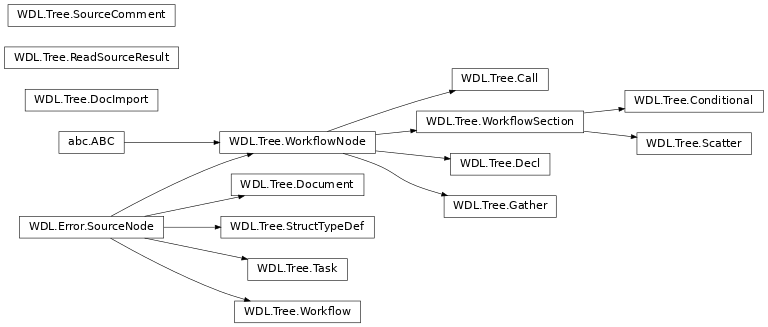
Abstract syntax tree (AST) for WDL documents, containing tasks and workflows, which contain
declarations, calls, and scatter & if sections. The AST is typically constructed by
load().
The WDL.Tree.* classes are also exported by the base WDL module, i.e. WDL.Tree.Document
can be abbreviated WDL.Document.
-
class
WDL.Tree.StructTypeDef(pos: WDL.Error.SourcePosition, name: str, members: Dict[str, WDL.Type.Base], imported: Optional[Tuple[WDL.Tree.Document, WDL.Tree.StructTypeDef]] = None)[source]¶ Bases:
WDL.Error.SourceNodeWDL struct type definition
-
name= None¶ Type: str Name of the struct type (in the current document)
-
members= None¶ Type: Dict[str, WDL.Type.Base] Member names and types
-
imported= None¶ Type: Optional[Tuple[Document,StructTypeDef]] If this struct is imported from another document, references that document and its definition there. The referenced definition might itself be imported from yet another document.
-
type_id¶ Type: str A string canonically describing the member names and their types, excluding the struct type name; useful to unify aliased struct types.
-
-
class
WDL.Tree.WorkflowNode(workflow_node_id: str, pos: WDL.Error.SourcePosition)[source]¶ Bases:
WDL.Error.SourceNode,abc.ABCBase class for workflow “nodes” including declarations, calls, and scatter/if sections and their bodies.
Each node has a human-readable ID string which is unique within the workflow. It also exposes the set of workflow node IDs upon which it depends. Abstractly, workflow execution can proceed by “visiting” each node once all of its dependencies have been visited, performing some action(s) appropriate to the specific node type (such as evaluating a WDL expression and binding a name in the environment, or executing a task and binding its outputs).
-
workflow_node_id= None¶ Type: str Human-readable node ID unique within the current workflow
-
scatter_depth= None¶ Type: int How many nested scatter sections the node lies within. This information is useful for runtime dependency analysis in workflows with scatters. When scatter sections are nested within conditional sections or vice versa, this counts the scatters only.
-
workflow_node_dependencies¶ Type: Set[str] Set of workflow node IDs on which this node depends. Available once workflow has been typechecked.
-
-
class
WDL.Tree.Decl(pos: WDL.Error.SourcePosition, type: WDL.Type.Base, name: str, expr: Optional[WDL.Expr.Base] = None, id_prefix='decl')[source]¶ Bases:
WDL.Tree.WorkflowNodeA value declaration within a task or workflow.
Within a task, the declarations can be viewed as “workflow nodes” insofar as they must be evaluated in an order consistent with their dependency structure, and ensured acyclic. The “workflow node IDs” of a task’s declarations are unique within the task only, and unrelated to the top-level workflow, if any, in the WDL document.
-
type= None¶ Type: WDL.Type.Base
-
name= None¶ Declared value name
Type: str
-
expr= None¶ Type: Optional[WDL.Expr.Base] Bound expression, if any
-
-
class
WDL.Tree.Task(pos: WDL.Error.SourcePosition, name: str, inputs: Optional[List[WDL.Tree.Decl]], postinputs: List[WDL.Tree.Decl], command: WDL.Expr.String, outputs: List[WDL.Tree.Decl], parameter_meta: Dict[str, Any], runtime: Dict[str, WDL.Expr.Base], meta: Dict[str, Any])[source]¶ Bases:
WDL.Error.SourceNodeWDL Task
-
name= None¶ Type: str
-
inputs= None¶ Type: Optional[List[WDL.Tree.Decl]] Declarations in the
input{}task section, if it’s present
-
postinputs= None¶ Type: List[WDL.Tree.Decl] Declarations outside of the
input{}task section
-
command= None¶ Type: WDL.Expr.String
-
outputs= None¶ Type: List[WDL.Tree.Decl] Output declarations
-
runtime= None¶ Type: Dict[str,WDL.Expr.Base] runtime{}section, with keys and corresponding expressions to be evaluated
-
available_inputs¶ Type: WDL.Env.Bindings[WDL.Tree.Decl] Yields the task’s input declarations. This is all declarations in the task’s
input{}section, if it’s present. Otherwise, it’s all declarations in the task, excluding outputs. (This dichotomy bridges pre-1.0 and 1.0+ WDL versions.)Each input is at the top level of the Env, with no namespace.
-
required_inputs¶ Type: WDL.Env.Bindings[WDL.Tree.Decl] Yields the input declarations which are required to call the task (available inputs that are unbound and non-optional).
Each input is at the top level of the Env, with no namespace.
-
effective_outputs¶ Type: WDL.Env.Bindings[Type.Base] Yields each task output with its type, at the top level of the Env with no namespace. (Present for isomorphism with
Workflow.effective_outputs)
-
-
class
WDL.Tree.Call(pos: WDL.Error.SourcePosition, callee_id: List[str], alias: Optional[str], inputs: Dict[str, WDL.Expr.Base])[source]¶ Bases:
WDL.Tree.WorkflowNodeA call (within a workflow) to a task or sub-workflow
-
callee_id= None¶ Type: List[str] The called task; either one string naming a task in the current document, or an import namespace and task name.
-
name= None¶ Type: string Call name, defaults to task/workflow name
-
inputs= None¶ Type: Dict[str,WDL.Expr.Base] Call inputs provided
-
callee= None¶ Type: Union[WDL.Tree.Task, WDL.Tree.Workflow] Refers to the
Taskor importedWorkflowobject to be called (after AST typechecking)
-
available_inputs¶ Type: WDL.Env.Bindings[WDL.Tree.Decl] Yields the task/workflow inputs which are not supplied in the call
inputs:, and thus may be supplied at workflow launch; in namespaces according to the call names.
-
required_inputs¶ Type: WDL.Env.Bindings[WDL.Tree.Decl] Yields the required task/workflow inputs which are not supplied in the call
inputs:(incomplete calls), and thus must be supplied at workflow launch; in namespaces according to the call name.
-
effective_outputs¶ Type: WDL.Env.Bindings[WDL.Tree.Decl] Yields the effective outputs of the callee Task or Workflow, in a namespace according to the call name.
-
-
class
WDL.Tree.Gather(section: WDL.Tree.WorkflowSection, referee: Union[WDL.Tree.Decl, WDL.Tree.Call, WDL.Tree.Gather])[source]¶ Bases:
WDL.Tree.WorkflowNodeA
Gathernode symbolizes the operation to gather an array of declared values or call outputs in a scatter section, or optional values from a conditional section. These operations are implicit in the WDL syntax, but explicating them in the AST facilitates analysis of the workflow’s data types and dependency structure.Each scatter/conditional section provides
Gathernodes to expose the section body’s products to the rest of the workflow. When aWDL.Expr.Identelsewhere identifies a node inside the section, itsrefereeattribute is the correspondingGathernode, which in turn references the interior node. The interior node might itself be anotherGathernode, from a nested scatter/conditional section.-
section= None¶ Type: WorkflowSection The
Scatter/Conditionalsection implying this Gather operation
-
referee= None¶ Type: Union[Decl, Call, Gather] The
Decl,Call, or sub-Gathernode from which this operation “gathers”
-
final_referee¶ The
DeclorCallnode found at the end of the referee chain through any nestedGathernodes
-
-
class
WDL.Tree.WorkflowSection(body: List[WDL.Tree.WorkflowNode], *args, **kwargs)[source]¶ Bases:
WDL.Tree.WorkflowNodeBase class for workflow nodes representing scatter and conditional sections
-
body= None¶ Type: List[WorkflowNode] Section body, potentially including nested sections.
-
gathers= None¶ Type: Dict[str, Gather] Gathernodes exposing the section body’s products to the rest of the workflow. The dict is keyed byworkflow_node_idof the interior node, to expedite looking up the corresponding gather node.The section’s body and gather nodes do not explicitly include the section node among their dependencies. Such dependence is implicit because the body subgraph can be “instantiated” only upon visiting the section node at runtime.
-
-
class
WDL.Tree.Scatter(pos: WDL.Error.SourcePosition, variable: str, expr: WDL.Expr.Base, body: List[WDL.Tree.WorkflowNode])[source]¶ Bases:
WDL.Tree.WorkflowSectionWorkflow scatter section
-
variable= None¶ Type: string Scatter variable name
-
expr= None¶ Type: WDL.Expr.Base Expression for the array over which to scatter
-
-
class
WDL.Tree.Conditional(pos: WDL.Error.SourcePosition, expr: WDL.Expr.Base, body: List[WDL.Tree.WorkflowNode])[source]¶ Bases:
WDL.Tree.WorkflowSectionWorkflow conditional (if) section
-
expr= None¶ Tree: WDL.Expr.Base Boolean expression
-
-
class
WDL.Tree.Workflow(pos: WDL.Error.SourcePosition, name: str, inputs: Optional[List[WDL.Tree.Decl]], body: List[WDL.Tree.WorkflowNode], outputs: Optional[List[WDL.Tree.Decl]], parameter_meta: Dict[str, Any], meta: Dict[str, Any], output_idents: Optional[List[List[str]]] = None, output_idents_pos: Optional[WDL.Error.SourcePosition] = None)[source]¶ Bases:
WDL.Error.SourceNode-
name= None¶ Type: str
-
inputs= None¶ Type: List[WDL.Tree.Decl] Declarations in the
input{}workflow section, if it’s present
-
body= None¶ Type: List[Union[WDL.Tree.Decl,WDL.Tree.Call,WDL.Tree.Scatter,WDL.Tree.Conditional]] Workflow body in between
input{}andoutput{}sections, if any
-
outputs= None¶ Type: Optional[List[WDL.Tree.Decl]] Workflow output declarations, if the
output{}section is present
-
complete_calls= None¶ After typechecking, False if the workflow has a call which does not supply all required inputs (and thus cannot be called from another workflow).
-
available_inputs¶ Type: WDL.Env.Bindings[WDL.Tree.Decl] The workflow’s input declarations. This includes:
1. If the
input{}workflow section is present, all declarations within that section. Otherwise, all declarations in the top-level workflow body, excluding outputs. (This dichotomy bridges pre-1.0 and 1.0+ WDL versions.) These appear at the top level of the Env, with no namespace.- Available inputs of all calls in the workflow, namespaced by the call names.
-
required_inputs¶ Type: WDL.Env.Bindings[Decl] The subset of available inputs which are required to start the workflow.
-
effective_outputs¶ Type: WDL.Env.Bindings[Decl] If the
output{}workflow section is present, yields the names and types therein, at the top level of the Env. Otherwise, yield all the call outputs, namespaced and typed appropriately.
-
-
class
WDL.Tree.SourceComment(pos, text)¶ Bases:
tuplePosition and text of a comment. The text includes the
#and any preceding or trailing spaces/tabs.-
pos¶ Alias for field number 0
-
text¶ Alias for field number 1
-
-
class
WDL.Tree.DocImport(pos, uri, namespace, aliases, doc)¶ Bases:
tupleRepresents one imported document, with position of the import statement, import URI, namespace, struct type aliases, and (after typechecking) the
Documentobject.-
aliases¶ Alias for field number 3
-
doc¶ Alias for field number 4
-
namespace¶ Alias for field number 2
-
pos¶ Alias for field number 0
-
uri¶ Alias for field number 1
-
-
class
WDL.Tree.Document(source_text: str, pos: WDL.Error.SourcePosition, imports: List[WDL.Tree.DocImport], struct_typedefs: Dict[str, WDL.Tree.StructTypeDef], tasks: List[WDL.Tree.Task], workflow: Optional[WDL.Tree.Workflow], comments: List[WDL.Tree.SourceComment], wdl_version: Optional[str])[source]¶ Bases:
WDL.Error.SourceNodeTop-level document, with imports, tasks, and up to one workflow. Typically returned by
load().-
struct_typedefs= None¶ Type: Env.Bindings[WDL.Tree.StructTypeDef]
-
tasks= None¶ Type: List[WDL.Tree.Task]
-
workflow= None¶ Type: Optional[WDL.Tree.Workflow]
-
source_text= None¶ Type: str Original WDL source code text
-
source_lines= None¶ Type: List[str] Original WDL source code text split by newlines.
SourcePositionline numbers are one-based, so line numberLcorresponds tosource_lines[L-1].
-
source_comments= None¶ Type: List[Optional[SourceComment]] Lookup table for source code comments.
source_commentshas the same length assource_lines, and each entry is theWDL.Tree.SourceCommentfound on the corresponding source line, orNoneif the line has no comment.
-
wdl_version= None¶ Type: Optional[str] Declared WDL language version; if absent, then assume draft-2.
-
Expr
WDL expressions composing literal values, arithmetic, comparison, conditionals, string interpolation, arrays & maps, and function applications. These appear on the right-hand side of value declarations and in task command substitutions, task runtime sections, and workflow scatter and conditional sections.
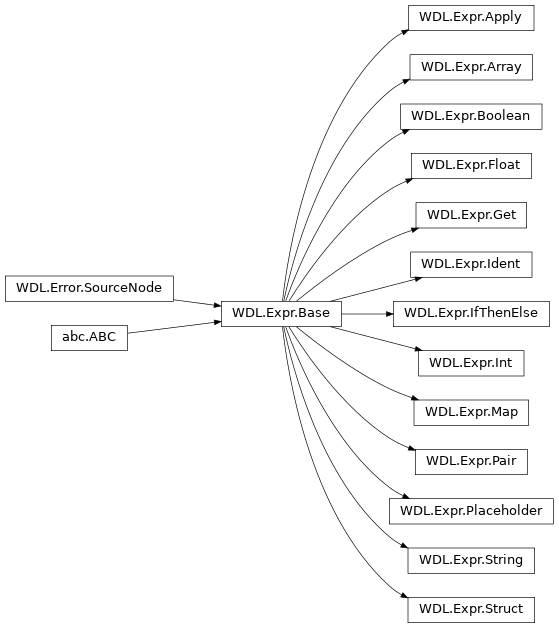
The abstract syntax tree (AST) for any expression is represented by an instance
of a Python class deriving from WDL.Expr.Base. Any such node may have other
nodes attached “beneath” it. An expression can be evaluated to a Value
given a suitable WDL.Env.Bindings[Value.Base].
-
class
WDL.Expr.Base(pos: WDL.Error.SourcePosition)[source]¶ Bases:
WDL.Error.SourceNode,abc.ABCSuperclass of all expression AST nodes
-
type¶ Type: WDL.Type.Base WDL type of this expression. Undefined on construction; populated by one invocation of
infer_type.
-
infer_type(self, type_env : Env.Bindings[Type.Base]) → WDL.Expr.Base[source]¶ Infer the expression’s type within the given type environment. Must be invoked exactly once prior to use of other methods.
Parameters: - stdlib – a context-specific standard function library for typechecking
- check_quant – when
False, disables static validation of the optional (?) type quantifier when typecheck() is called on this expression, so for example typeT?can satisfy an expected typeT. Applies recursively to the type inference and checking of any sub-expressions.
Raises: WDL.Error.StaticTypeMismatch – when the expression fails to type-check
Returns: self
-
typecheck(self, expected : Type.Base) → WDL.Expr.Base[source]¶ Check that this expression’s type is, or can be coerced to,
expected.Raises: WDL.Error.StaticTypeMismatch – Returns: self
-
-
class
WDL.Expr.Boolean(pos: WDL.Error.SourcePosition, literal: bool)[source]¶ Bases:
WDL.Expr.BaseBoolean literal
-
value= None¶ Type: bool Literal value
-
-
class
WDL.Expr.Int(pos: WDL.Error.SourcePosition, literal: int)[source]¶ Bases:
WDL.Expr.BaseInteger literal
-
value= None¶ Type: int Literal value
-
-
class
WDL.Expr.Float(pos: WDL.Error.SourcePosition, literal: float)[source]¶ Bases:
WDL.Expr.BaseNumeric literal
-
value= None¶ Type: float Literal value
-
-
class
WDL.Expr.Placeholder(pos: WDL.Error.SourcePosition, options: Dict[str, str], expr: WDL.Expr.Base)[source]¶ Bases:
WDL.Expr.BaseHolds an expression interpolated within a string or command
-
options= None¶ Type: Dict[str,str] Placeholder options (sep, true, false, default)
-
expr= None¶ Type: WDL.Expr.Base Expression to be evaluated and substituted
-
children¶ Type: Iterable[SourceNode] Yield all child nodes
-
infer_type(self, type_env : Env.Bindings[Type.Base]) → WDL.Expr.Base[source]¶ Infer the expression’s type within the given type environment. Must be invoked exactly once prior to use of other methods.
Parameters: - stdlib – a context-specific standard function library for typechecking
- check_quant – when
False, disables static validation of the optional (?) type quantifier when typecheck() is called on this expression, so for example typeT?can satisfy an expected typeT. Applies recursively to the type inference and checking of any sub-expressions.
Raises: WDL.Error.StaticTypeMismatch – when the expression fails to type-check
Returns: self
-
-
class
WDL.Expr.String(pos: WDL.Error.SourcePosition, parts: List[Union[str, WDL.Expr.Placeholder]], command: bool = False)[source]¶ Bases:
WDL.Expr.BaseString literal, possibly interleaved with expression placeholders for interpolation
-
parts= None¶ Type: List[Union[str,WDL.Expr.Placeholder]] The parts list begins and ends with matching single- or double- quote marks. Between these is a sequence of literal strings and/or interleaved placeholder expressions. Escape sequences in the literals have NOT been decoded.
-
command= None¶ Type: bool True if this expression is a task command template, as opposed to a string expression anywhere else. Controls whether backslash escape sequences are evaluated or (for commands) passed through for shell interpretation.
-
children¶ Type: Iterable[SourceNode] Yield all child nodes
-
-
class
WDL.Expr.Array(pos: WDL.Error.SourcePosition, items: List[WDL.Expr.Base])[source]¶ Bases:
WDL.Expr.BaseArray literal
-
items= None¶ Type: List[WDL.Expr.Base] Expression for each item in the array literal
-
children¶ Type: Iterable[SourceNode] Yield all child nodes
-
-
class
WDL.Expr.Pair(pos: WDL.Error.SourcePosition, left: WDL.Expr.Base, right: WDL.Expr.Base)[source]¶ Bases:
WDL.Expr.BasePair literal
-
left= None¶ Type: WDL.Expr.Base Left-hand expression in the pair literal
-
right= None¶ Type: WDL.Expr.Base Right-hand expression in the pair literal
-
children¶ Type: Iterable[SourceNode] Yield all child nodes
-
-
class
WDL.Expr.Map(pos: WDL.Error.SourcePosition, items: List[Tuple[WDL.Expr.Base, WDL.Expr.Base]])[source]¶ Bases:
WDL.Expr.BaseMap literal
-
items= None¶ Type: List[Tuple[WDL.Expr.Base,WDL.Expr.Base]] Expressions for the map literal keys and values
-
children¶ Type: Iterable[SourceNode] Yield all child nodes
-
-
class
WDL.Expr.Struct(pos: WDL.Error.SourcePosition, members: List[Tuple[str, WDL.Expr.Base]])[source]¶ Bases:
WDL.Expr.BaseStruct literal
-
members= None¶ Type: Dict[str,WDL.Expr.Base] The struct literal is modelled initially as a bag of keys and values, which can be coerced to a specific struct type during typechecking.
-
children¶ Type: Iterable[SourceNode] Yield all child nodes
-
-
class
WDL.Expr.IfThenElse(pos: WDL.Error.SourcePosition, condition: WDL.Expr.Base, consequent: WDL.Expr.Base, alternative: WDL.Expr.Base)[source]¶ Bases:
WDL.Expr.BaseTernary conditional expression
-
condition= None¶ Type: WDL.Expr.Base A Boolean expression for the condition
-
consequent= None¶ Type: WDL.Expr.Base Expression evaluated when the condition is true
-
alternative= None¶ Type: WDL.Expr.Base Expression evaluated when the condition is false
-
children¶ Type: Iterable[SourceNode] Yield all child nodes
-
-
class
WDL.Expr.Ident(pos: WDL.Error.SourcePosition, name: str)[source]¶ Bases:
WDL.Expr.BaseAn identifier referencing a named value or call output.
Identnodes are wrapped inGetnodes, as discussed below.-
name= None¶ Type: str Name, possibly including a dot-separated namespace
-
referee= None¶ After typechecking within a task or workflow, stores the AST node to which the identifier refers: a
WDL.Tree.Declfor value references; aWDL.Tree.Callfor call outputs; aWDL.Tree.Scatterfor scatter variables; or aWDL.Tree.Gatherobject representing a value or call output that resides within a scatter or conditional section.
-
children¶ Type: Iterable[SourceNode] Yield all child nodes
-
-
class
WDL.Expr.Get(pos: WDL.Error.SourcePosition, expr: WDL.Expr.Base, member: Optional[str])[source]¶ Bases:
WDL.Expr.BaseAST node representing access to a value by identifier (including namespaced ones), or accessing a member of a pair or struct as
.member.The entaglement of these two cases is inherent in WDL. Consider the syntax
leftname.midname.rightname. One interpretation is thatleftnameis an identifier for a struct value, and.midname.rightnamerepresents a chain of struct member accesses. But another possibility is thatleftnameis a call,midnameis a struct output of that call, andrightnameis a member of that struct. These cases can’t be distinguished by the syntax parser alone, but must be resolved during typechecking with reference to the calls and identifiers available in the environment.The typechecker does conveniently resolve such cases, and to minimize the extent to which it has to restructure the AST in doing so, all identifiers (with or without a namespace) are represented as a
Getnode wrapping anIdentnode. TheGetnode may specify a member name to access, but may not if the identifier is to be accessed directly. On the other hand, the expression inside aGetnode need not be a simple identifier, e.g.arr[1].memb.leftis be represented as:Get(Get(Apply("_at", Get(Ident("arr")), 1),"memb"),"left")-
expr= None¶ Type: WDL.Expr.Base The expression whose value is accessed
-
member= None¶ Type: Optional[str] If the expression is accessing a pair/struct member, then
expr.typeisWDL.Type.PairorWDL.Type.StructInstanceand this field gives the desired member name (leftorrightfor pairs).Otherwise the expression accesses
exprdirectly, andmemberisNone.
-
children¶ Type: Iterable[SourceNode] Yield all child nodes
-
-
class
WDL.Expr.Apply(pos: WDL.Error.SourcePosition, function: str, arguments: List[WDL.Expr.Base])[source]¶ Bases:
WDL.Expr.BaseApplication of a built-in or standard library function
-
function_name= None¶ Name of the function applied
Type: str
-
arguments= None¶ Type: List[WDL.Expr.Base] Expressions for each function argument
-
children¶ Type: Iterable[SourceNode] Yield all child nodes
-
Env
Environments, for identifier resolution during WDL typechecking and evaluation.
-
class
WDL.Env.Binding(name: str, value: T, info: Any = None)[source]¶ Bases:
typing.GenericAn individual, immutable binding of a possibly-namespaced name to a right-hand-side value of type
T.Tis typicallyValue.Base(value environments) orType.Base(type environments). The binding may also reference an additional informational value of arbitrary type.-
name¶ Type: str Namedspaced names are flat, dot-separated strings.
-
value¶ Type: T
-
-
class
WDL.Env.Bindings(binding: Optional[WDL.Env.Binding[T]] = None, next: Optional[WDL.Env.Bindings[T]] = None)[source]¶ Bases:
typing.GenericAn environment consisting of an immutable linked-list of
WDL.Env.Bindingobjects.WDL.Env.Bindings()is the empty environment.Bindings[T]is iterable for the individualBinding[T]objects:env = WDL.Env.Bindings() env = env.bind("x", 1).bind("y", 42) print(env["x"]) # 1 print(",".join(str(b.value) for b in env)) # 1,42
-
bind(name: str, value: T, info: Any = None) → WDL.Env.Bindings[~T][T][source]¶ Return an environment with a new binding prepended. Any existing binding for the same name is shadowed by the new one. (This should not usually arise in view of the immutability of WDL values.)
-
resolve_binding(name: str) → WDL.Env.Binding[~T][T][source]¶ Look up a
WDL.Env.Bindingobject by nameRaises: KeyError – no such binding
-
resolve(name: str) → T[source]¶ Look up a bound value by name. Equivalently,
env[name]Raises: KeyError – no such binding
-
has_binding(name: str) → bool[source]¶ Determine existence of a binding for the name. Equivalently,
name in env
-
map(f: Callable[[WDL.Env.Binding[~T][T]], Optional[WDL.Env.Binding[~S][S]]]) → WDL.Env.Bindings[~S][S][source]¶ Copy the environment with each binding transformed by the given function. If the function returns
Nonethen the binding is excluded.
-
filter(pred: Callable[[WDL.Env.Binding[~T][T]], bool]) → WDL.Env.Bindings[~T][T][source]¶ Copy the environment with only those bindings for which
predreturns True
-
subtract(rhs: WDL.Env.Bindings[~S][S]) → WDL.Env.Bindings[~T][T][source]¶ Copy the environment excluding any binding for which
rhshas a binding with the same name
-
namespaces¶ Type: Set[str] Return the environment’s namespaces, all the distinct dot-separated prefixes of the binding names. Each element ends with a dot.
-
enter_namespace(namespace: str) → WDL.Env.Bindings[~T][T][source]¶ Generate an environment with only those bindings in the given namespace, with the namespace prefix removed from each binding’s name.
-
Type
WDL data types
WDL has both atomic types such as Int, Boolean, and String; and
parametric types like Array[String] and
Map[String,Array[Array[Float]]]. Here, each type is represented by an
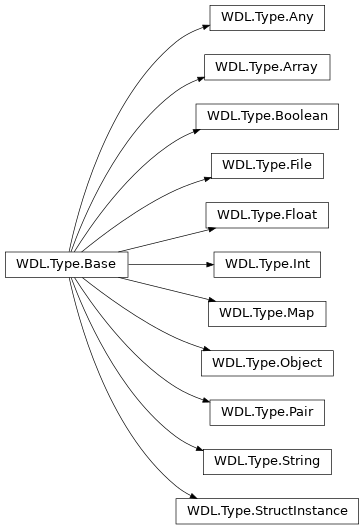
immutable instance of a Python class inheriting from WDL.Type.Base. Such
types are associated with expressions, statically prior to evaluation, as well
as with values and identifier bindings after evaluation.
An atomic type like Int is represented by WDL.Type.Int(). Atomic types
can be checked either with isinstance(t,WDL.Type.Int), which ignores the
possible optional quantifier (thus satisfied by Int or Int?), or with
t == WDL.Type.Int(optional=True) to include the quantifier in the
comparison.
A parametric type like Array[String] is represented by
WDL.Type.Array(WDL.Type.String()). Any kind of array satisfies
isinstance(t,WDL.Type.Array), and
WDL.Type.Array(WDL.Type.String()) == WDL.Type.Array(WDL.Type.String()), but
for example
WDL.Type.Array(WDL.Type.String()) != WDL.Type.Array(WDL.Type.Float()).
The type classes include a method indicating if a value of the type can be coerced to some other desired type, according to the following rules:
Intcoerces toFloatBoolean,Int,Float, andFilecoerce toStringStringcoerces toFile,Int, andFloatArray[T]coerces toStringprovidedTdoes as wellTcoerces toT?but the reverse is not true in general*Array[T]+coerces toArray[T]but the reverse is not true in general*
(*) The reverse coercions are statically permitted in expressions set up with
Expr.infer_type(check_quant=False) although they may fail at runtime. This
also enables coercion of T to Array[T]+ (an array of length 1).
-
class
WDL.Type.Base[source]¶ Bases:
abc.ABCThe abstract base class for WDL types
Each specific type inherits from this base, e.g.:
assert issubclass(WDL.Type.Int, WDL.Type.Base)
assert isinstance(WDL.Type.Array(WDL.Type.Int()), WDL.Type.Base)
All instances are immutable.
-
coerces(rhs: WDL.Type.Base, check_quant: bool = True) → bool[source]¶ True if this is the same type as, or can be coerced to,
rhs.Parameters: check_quant – when False, disables static enforcement of the optional (?) type quantifier
-
optional¶ Type: bool True when the type has the optional quantifier,
T?
-
parameters¶ Type: Iterable[WDL.Type.Base] The type’s parameters, if any (e.g. item type of Array; left & right types of Pair; etc.)
-
-
class
WDL.Type.Any(optional: bool = False)[source]¶ Bases:
WDL.Type.BaseA symbolic type which coerces to any other type; used to represent e.g. the item type of an empty array literal, or the result of read_json().
-
class
WDL.Type.Boolean(optional: bool = False)[source]¶ Bases:
WDL.Type.Base
-
class
WDL.Type.Float(optional: bool = False)[source]¶ Bases:
WDL.Type.Base
-
class
WDL.Type.Int(optional: bool = False)[source]¶ Bases:
WDL.Type.Base
-
class
WDL.Type.File(optional: bool = False)[source]¶ Bases:
WDL.Type.Base
-
class
WDL.Type.String(optional: bool = False)[source]¶ Bases:
WDL.Type.Base
-
class
WDL.Type.Array(item_type: WDL.Type.Base, optional: bool = False, nonempty: bool = False)[source]¶ Bases:
WDL.Type.BaseArray type, parameterized by the type of the constituent items.
-
item_type= None¶ Type: WDL.Type.Base item_typemay beAnywhen not known statically, such as in a literal empty array[].
-
nonempty¶ Type: bool True when the type has the nonempty quantifier,
Array[T]+
-
parameters¶ Type: Iterable[WDL.Type.Base] The type’s parameters, if any (e.g. item type of Array; left & right types of Pair; etc.)
-
-
class
WDL.Type.Map(item_type: Tuple[WDL.Type.Base, WDL.Type.Base], optional: bool = False, literal_keys: Optional[Set[str]] = None)[source]¶ Bases:
WDL.Type.BaseMap type, parameterized by the (key,value) item type.
-
item_type= None¶ Type: Tuple[WDL.Type.Base,WDL.Type.Base] The key and value types may be
Anywhen not known statically, such as in a literal empty map{}.
-
literal_keys= None
-
parameters¶ Type: Iterable[WDL.Type.Base] The type’s parameters, if any (e.g. item type of Array; left & right types of Pair; etc.)
-
-
class
WDL.Type.Pair(left_type: WDL.Type.Base, right_type: WDL.Type.Base, optional: bool = False)[source]¶ Bases:
WDL.Type.BasePair type, parameterized by the left and right item types.
-
left_type= None¶ Type: WDL.Type.Base
-
right_type= None¶ Type: WDL.Type.Base
-
parameters¶ Type: Iterable[WDL.Type.Base] The type’s parameters, if any (e.g. item type of Array; left & right types of Pair; etc.)
-
-
class
WDL.Type.StructInstance(type_name: str, optional: bool = False)[source]¶ Bases:
WDL.Type.BaseType of an instance of a struct
Not to be confused with struct type definition,
WDL.Tree.StructTypeDef. To find theWDL.Tree.StructTypeDefin the currentdoc: WDL.Tree.Documentcorresponding toty: WDL.Type.StructInstance, usedoc.struct_typedefs[ty.type_name].-
type_name= None¶ Type: str The struct type name with which the instance is declared; note that the same struct type can go by different names.
-
members= None¶ Type: Dict[str,WDL.Type.Base] Names and types of the struct members, from the struct type definition (available after typechecking)
-
type_id¶ Type: str A string canonically describing the member names and their types, excluding the struct type name; useful to unify aliased struct types.
-
parameters¶ Type: Iterable[WDL.Type.Base] The type’s parameters, if any (e.g. item type of Array; left & right types of Pair; etc.)
-
-
WDL.Type.unify(types: List[WDL.Type.Base], check_quant: bool = True, force_string: bool = False) → WDL.Type.Base[source]¶ Given a list of types, compute a type to which they’re all coercible, or
WDL.Type.Anyif no more-specific inference is possible.Parameters: force_string – permit last-resort unification to Stringeven if no item is currently aString, but all can be coerced
Value
WDL values instantiated at runtime
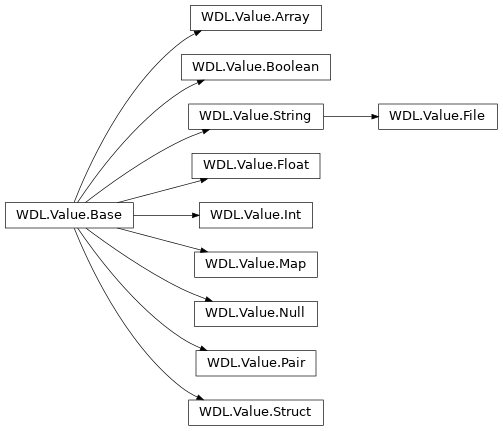
Each value is represented by an instance of a Python class inheriting from
WDL.Value.Base.
-
class
WDL.Value.Base(type: WDL.Type.Base, value: Any, expr: Optional[Expr.Base] = None)[source]¶ Bases:
abc.ABCThe abstract base class for WDL values
-
type= None¶ Type: WDL.Type.Base
-
value= None¶ The “raw” Python value
-
expr= None¶ Reference to the WDL expression that generated this value, if it originated from
WDL.Expr.eval
-
coerce(desired_type: Optional[WDL.Type.Base] = None) → WDL.Value.Base[source]¶ Coerce the value to the desired type and return it. Types should be checked statically on
WDL.Expr.Baseprior to evaluation.Raises: ReferenceError for a null value and non-optional type
-
json¶ Return a value representation which can be serialized to JSON using
json.dumps(str, int, float, list, dict, or null)
-
-
class
WDL.Value.Boolean(value: bool, expr: Optional[Expr.Base] = None)[source]¶ Bases:
WDL.Value.Basevaluehas Python typebool
-
class
WDL.Value.Float(value: float, expr: Optional[Expr.Base] = None)[source]¶ Bases:
WDL.Value.Basevaluehas Python typefloat
-
class
WDL.Value.Int(value: int, expr: Optional[Expr.Base] = None)[source]¶ Bases:
WDL.Value.Basevaluehas Python typeint
-
class
WDL.Value.String(value: str, expr: Optional[Expr.Base] = None)[source]¶ Bases:
WDL.Value.Basevaluehas Python typestr
-
class
WDL.Value.File(value: str, expr: Optional[Expr.Base] = None)[source]¶ Bases:
WDL.Value.Stringvaluehas Python typestr
-
class
WDL.Value.Array(item_type: WDL.Type.Base, value: List[WDL.Value.Base], expr: Optional[Expr.Base] = None)[source]¶ Bases:
WDL.Value.Basevalueis a Pythonlistof otherWDL.Value.Baseinstances
-
class
WDL.Value.Map(item_type: Tuple[WDL.Type.Base, WDL.Type.Base], value: List[Tuple[WDL.Value.Base, WDL.Value.Base]], expr: Optional[Expr.Base] = None)[source]¶ Bases:
WDL.Value.Base
-
class
WDL.Value.Pair(left_type: WDL.Type.Base, right_type: WDL.Type.Base, value: Tuple[WDL.Value.Base, WDL.Value.Base], expr: Optional[Expr.Base] = None)[source]¶ Bases:
WDL.Value.Base
-
class
WDL.Value.Null(expr: Optional[Expr.Base] = None)[source]¶ Bases:
WDL.Value.BaseRepresents the missing value which optional inputs may take.
typeandvalueare both None.
-
class
WDL.Value.Struct(type: Union[WDL.Type.Object, WDL.Type.StructInstance], value: Dict[str, WDL.Value.Base], expr: Optional[Expr.Base] = None)[source]¶ Bases:
WDL.Value.Base
-
WDL.Value.from_json(type: WDL.Type.Base, value: Any) → WDL.Value.Base[source]¶ Instantiate a WDL value of the specified type from a parsed JSON value (str, int, float, list, dict, or null).
If type is
WDL.Type.Any(), attempts to infer a WDL type & value from the JSON’s intrinsic types. This isn’t ideal; for example, Files can’t be distinguished from Strings, and JSON lists and dicts with heterogeneous item types may give undefined results.Raises: WDL.Error.InputError – if the given value isn’t coercible to the specified type
Error
-
class
WDL.Error.SourcePosition[source]¶ Bases:
WDL.Error.SourcePositionSource position attached to AST nodes and exceptions; NamedTuple of
urithe filename/URI passed toWDL.load()or a WDL import statement, which may be relative;abspaththe absolute filename/URI; and one-based int positionslineend_linecolumnend_column
-
exception
WDL.Error.SyntaxError(pos: WDL.Error.SourcePosition, msg: str, wdl_version: str, declared_wdl_version: Optional[str])[source]¶ Bases:
ExceptionFailure to lex/parse a WDL document
-
exception
WDL.Error.ImportError(pos: WDL.Error.SourcePosition, import_uri: str, message: Optional[str] = None)[source]¶ Bases:
ExceptionFailure to open/retrieve an imported WDL document
The
__cause__attribute may hold the inner error object.
-
class
WDL.Error.SourceNode(pos: WDL.Error.SourcePosition)[source]¶ Bases:
objectBase class for an AST node, recording the source position
-
pos= None¶ Type: SourcePosition Source position for this AST node
-
children¶ Type: Iterable[SourceNode] Yield all child nodes
-
-
exception
WDL.Error.ValidationError(node: Union[WDL.Error.SourceNode, WDL.Error.SourcePosition], message: str)[source]¶ Bases:
ExceptionBase class for a WDL validation error (when the document loads and parses, but fails typechecking or other static validity tests)
-
source_text= None¶ Type: Optional[str] The complete source text of the WDL document (if available)
-
node= None¶ Type: Optional[SourceNode]
-
pos= None¶ Type: SourcePosition
-
-
exception
WDL.Error.InvalidType(node: Union[WDL.Error.SourceNode, WDL.Error.SourcePosition], message: str)[source]¶ Bases:
WDL.Error.ValidationError
-
exception
WDL.Error.IndeterminateType(node: Union[WDL.Error.SourceNode, WDL.Error.SourcePosition], message: str)[source]¶ Bases:
WDL.Error.ValidationError
-
exception
WDL.Error.NoSuchTask(node: Union[WDL.Error.SourceNode, WDL.Error.SourcePosition], name: str)[source]¶ Bases:
WDL.Error.ValidationError
-
exception
WDL.Error.NoSuchFunction(node: WDL.Error.SourceNode, name: str)[source]¶ Bases:
WDL.Error.ValidationError
-
exception
WDL.Error.WrongArity(node: WDL.Error.SourceNode, expected: int)[source]¶ Bases:
WDL.Error.ValidationError
-
exception
WDL.Error.NotAnArray(node: WDL.Error.SourceNode)[source]¶ Bases:
WDL.Error.ValidationError
-
exception
WDL.Error.NoSuchMember(node: WDL.Error.SourceNode, member: str)[source]¶ Bases:
WDL.Error.ValidationError
-
exception
WDL.Error.StaticTypeMismatch(node: WDL.Error.SourceNode, expected: WDL.Type.Base, actual: WDL.Type.Base, message: str = '')[source]¶ Bases:
WDL.Error.ValidationError
-
exception
WDL.Error.IncompatibleOperand(node: WDL.Error.SourceNode, message: str)[source]¶ Bases:
WDL.Error.ValidationError
-
exception
WDL.Error.UnknownIdentifier(node: WDL.Error.SourceNode)[source]¶ Bases:
WDL.Error.ValidationError
-
exception
WDL.Error.NoSuchInput(node: WDL.Error.SourceNode, name: str)[source]¶ Bases:
WDL.Error.ValidationError
-
exception
WDL.Error.UncallableWorkflow(node: WDL.Error.SourceNode, name: str)[source]¶ Bases:
WDL.Error.ValidationError
-
exception
WDL.Error.MultipleDefinitions(node: Union[WDL.Error.SourceNode, WDL.Error.SourcePosition], message: str)[source]¶ Bases:
WDL.Error.ValidationError
-
exception
WDL.Error.StrayInputDeclaration(node: Union[WDL.Error.SourceNode, WDL.Error.SourcePosition], message: str)[source]¶ Bases:
WDL.Error.ValidationError
-
exception
WDL.Error.CircularDependencies(node: WDL.Error.SourceNode)[source]¶ Bases:
WDL.Error.ValidationError
-
exception
WDL.Error.MultipleValidationErrors(*exceptions)[source]¶ Bases:
ExceptionPropagates several validation/typechecking errors
-
exceptions= None¶ Type: List[ValidationError]
-
-
exception
WDL.Error.EvalError(node: Union[WDL.Error.SourceNode, WDL.Error.SourcePosition], message: str)[source]¶ Bases:
WDL.Error.RuntimeErrorError evaluating a WDL expression or declaration
-
node= None¶ Type: Optional[SourceNode]
-
pos= None¶ Type: SourcePosition
-
-
exception
WDL.Error.OutOfBounds(node: WDL.Error.SourceNode)[source]¶ Bases:
WDL.Error.EvalError
-
exception
WDL.Error.EmptyArray(node: WDL.Error.SourceNode)[source]¶ Bases:
WDL.Error.EvalError
-
exception
WDL.Error.NullValue(node: Union[WDL.Error.SourceNode, WDL.Error.SourcePosition])[source]¶ Bases:
WDL.Error.EvalError
-
exception
WDL.Error.InputError[source]¶ Bases:
WDL.Error.RuntimeErrorError reading an input value/file
Lint
Annotate WDL document AST with hygiene warnings (underlies miniwdl check)
Given a doc: WDL.Document, the lint warnings can be retrieved like so:
lint = WDL.Lint.collect(WDL.Lint.lint(doc, descend_imports=False))
for (pos, lint_class, message, suppressed) in lint:
    assert isinstance(pos, WDL.SourcePosition)
    assert isinstance(lint_class, str) and isinstance(message, str)
    if not suppressed:
        print(json.dumps({
            "uri"        : pos.uri,
            "abspath"    : pos.abspath,
            "line"       : pos.line,
            "end_line"   : pos.end_line,
            "column"     : pos.column,
            "end_column" : pos.end_column,
            "lint"       : lint_class,
            "message"    : message,
        }))
The descend_imports flag controls whether lint warnings are generated for imported documents
recursively (true, default), or otherwise only the given document (false).
runtime
The recommended way to run a WDL workflow programmatically is to invoke miniwdl run as a
subprocess, capturing its JSON standard output. This leverages its logging, configuration, and
flexible input loading features; and avoids conflicting with the runtime’s thread pools and signal
handlers. Alternatively, it’s possible to call WDL.runtime.run() directly if needed.
-
WDL.runtime.run(cfg: WDL.runtime.config.Loader, exe: Union[WDL.Tree.Task, WDL.Tree.Workflow], inputs: WDL.Env.Bindings[WDL.Value.Base][WDL.Value.Base], **run_kwargs) → Tuple[str, WDL.Env.Bindings[WDL.Value.Base][WDL.Value.Base]][source]¶ Run the task or workflow given the inputs environment and configuration, returning the outputs environment.
inputsmay be parsed from a JSON dict usingvalues_from_json(), which can also validate them; see example below.Parameters: - run_id – a run identifier used in logs and filenames; defaults to executable name
- run_dir – directory under which to create a timestamp-named subdirectory for this run
(defaults to current working directory).
If the final path component is
.then operate in run_dir directly.
Typical usage:
# Convert JSON-like inputs dict to WDL environment, validating them against exe's available
# and required inputs. The dict keys should NOT be namespaced by the executable name;
# if namespaces are present, then add namespace=exe.name to effectively remove them.
inputs_env = WDL.values_from_json(inputs_dict, exe.available_inputs, exe.required_inputs)
# Load configuration (see below)
cfg = WDL.runtime.config.Loader(logging.getLogger(__name__))
# Run executable
run_subdir, outputs_env = WDL.runtime.run(cfg, exe, inputs_env, run_dir="/tmp")
# Generate JSON-like outputs dict, with keys namespaced by the executable name
outputs_dict = WDL.values_to_json(outputs_env, exe.name)
-
class
WDL.runtime.config.Loader(logger: logging.Logger, filenames: Optional[List[str]] = None, overrides: Optional[Dict[str, Dict[str, str]]] = None)[source]¶ Runtime configuration options, identified by section & key, are sourced in the following priority order:
- Supplied
overridesdict,{"section": {"key": value}} - Environment variables
MINIWDL__SECTION__KEY(uppercased with double-underscores) - Custom configuration file (mutually exclusive):
- filename given to
__init__ - file named by environment variable
MINIWDL_CFG miniwdl.cfgin XDG_CONFIG_HOME or XDG_CONFIG_DIRS, usually~/.config/miniwdl.cfg
- filename given to
WDL/runtime/config_templates/default.cfgfrom installed package
If
filenamesis an empty list, then no custom configuration file is used. Orfilenamesmay be a prioritized list of candidate filenames instead of (a-c) above; the first extant file is used, if any.- Supplied